The state of play
Australia is experiencing a rise in apartment living and increasing EV adoption. According to the 2021 Census, over 2.5 million Australians – or more than 10% – now reside in apartments. Simultaneously, the popularity of EVs is growing, with predictions that by 2030, half of all new cars will be electric.
Having the right infrastructure is essential to facilitating EV charging in residential and commercial buildings. New (greenfield) and existing (brownfield) buildings require similar backbone infrastructure – especially when multiple chargers are to be installed and used. Whether they already have this infrastructure in place is the big question.
What infrastructure is needed for EV-ready buildings?
Each building is unique – with varying power capacities/supply and demand (peak and off-peak), parking layout, existing electrical infrastructure, age of building, solar installations, storage and other specific requirements.
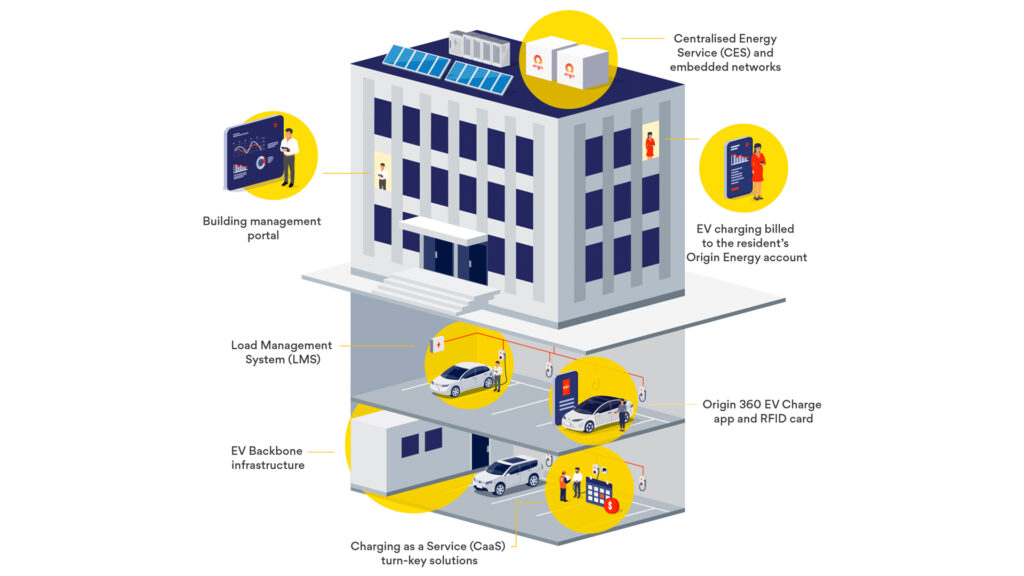
Buildings requiring multiple EV chargers need an energy distribution system – or ‘backbone’ – as well as a dynamic load management system (LMS) to safely manage the building’s power.
The LMS prioritises the power required by the building and its residents while distributing surplus energy for EV charging, balancing the building’s energy needs and the demands of multiple EV chargers.
What’s the difference between new and existing builds?
To future-proof new buildings, the National Construction Code (NCC) 2022 has mandated all class 2 residential buildings to provide EV-ready infrastructure to 100% car park spots, facilitating the easy installation of EV chargers as needed. However, existing buildings may or may not have this infrastructure in place.
Approximately 1 in 4 Victorians live in strata-managed residential buildings that haven’t been set up for EV charging, leaving those with an EV – or considering making the switch – without the option to charge at home.
Deploying backbone infrastructure and LMS in existing apartment buildings has added layers of complexity and cost, compared to new builds.
We’re working with ARENA to address this issue for owners’ corporations and residents in apartment buildings, helping Australians overcome barriers to EV adoption.
We’re developing a solution for existing buildings that includes EV charging technology along with backbone infrastructure. ARENA has provided $4.2 million through its Driving the Nation program to help fund 16 projects across the country.

How different is this to installing a single-dwelling charger?
The primary difference between installing a home charger in a single dwelling and setting up multiple chargers in high-density residential or commercial buildings lies in the scale of infrastructure required.
A single home needs minimal setup, while buildings with multiple tenants require a more robust EV backbone to handle higher electrical loads. This ensures efficient, simultaneous charging for multiple vehicles while maintaining the overall power balance for the building.
What types of EV chargers are available?
There are three main types of EV chargers: standard wall socket chargers, AC dedicated wall or pole-mounted chargers, and fast or rapid DC chargers for public use.
What software is required?
Our dedicated software platform, Origin 360 EV Charge, provides building managers with a customised dashboard with a view of all chargers, their locations and operating status.
The software simplifies and secures access to EV chargers using RFID cards and a mobile phone app, streamlining billing and reimbursement for building managers and residents.
Benefits for residents
- Convenient EV charging: Residents can schedule their charging for off-peak times and make the most of lower electricity rates if on a time of use energy tariff. The cost of charging can, depending on the technology, be billed directly back to their electricity account.
- Public charger access: Residents may also have access to public EV chargers while on the road through consolidated charging services, which could also include the convenience of a single billing account.
Benefits for owner’s corporations
- Future proof your building: Amenities that help make life easier for residents may drive increased rental demand and return.
- EV charger monetisation: Offer shared EV charging facilities and pass on the charging costs to the user. Smart charging software monitors charging and can collect payments from users, ensuring charging costs are reimbursed to building management.
Charging as a service (CAAS) subscription
To reduce upfront costs, Origin 360 EV offers Charging as a Service (CaaS), a low-risk way to get your building EV ready. How does this work? We design, fund, build, and maintain your EV charging infrastructure for a fixed monthly fee.
Want to learn more?