Our team of experts is here to help your organisation find tailored solutions to meet its energy needs and support its decarbonisation journey.
Table of contents
1. Energy Market reports
2. Product explainer: Virtual power plant
3. Customer stories: Melbourne City Football Club
4. Origin news and updates
4.1 Origin has agreed to acquire the Yanco Delta Wind Farm in the Riverina
4.2 Origin acquires renewables developer Walcha Energy
5. Energy market updates and reports
5.1 The expanded Capacity Investment Scheme
5.2 Renewables continued to increase NEM market share
1. Energy Market reports
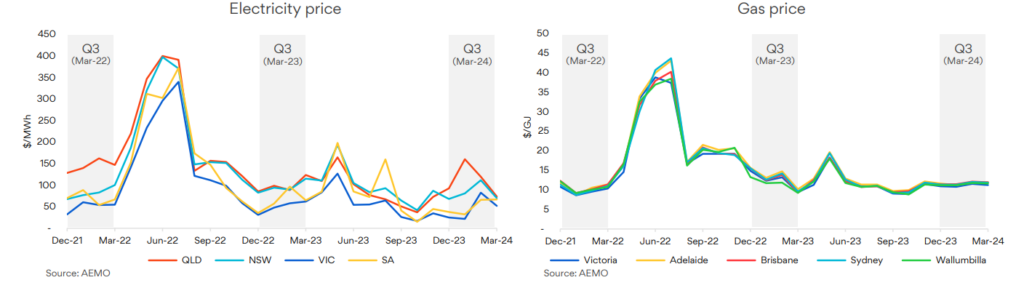
The average NEM spot electricity price for the March 2024 quarter was $78/MWh:
- $30/MWh higher than Dec-23 quarter, reflecting higher demand from warmer weather and increased interconnector and baseload generator outages.
- $5/MWh lower than Mar-23 quarter, reflecting stronger baseload generator availability and higher renewable generation Source: AEMO Gas price Q3 (Mar-23) Q3 (Mar-24) Electricity price Q3 (Mar-22) Q3 (Mar-22).
- Average domestic spot gas price for Mar-24 quarter was $12/GJ, relatively flat on both Dec-23 quarter and Mar-23 quarter.
2. Product explainer
Virtual power plant
Origin’s Virtual Power Plant (VPP), also known as ‘Origin Loop’, uses smart meter data and AI to aggregate and orchestrate hundreds of thousands of distributed energy sources in homes and businesses to help relieve pressure on the grid in times of high demand.
The video below is an example of a business customer connected to the VPP with solar, battery, and other assets. It demonstrates how Origin Loop can assist business customers in lowering their costs and CO2 emissions.
Learn more how Origin Loop can benefit your business
3. Customer stories
Melbourne City Football Club
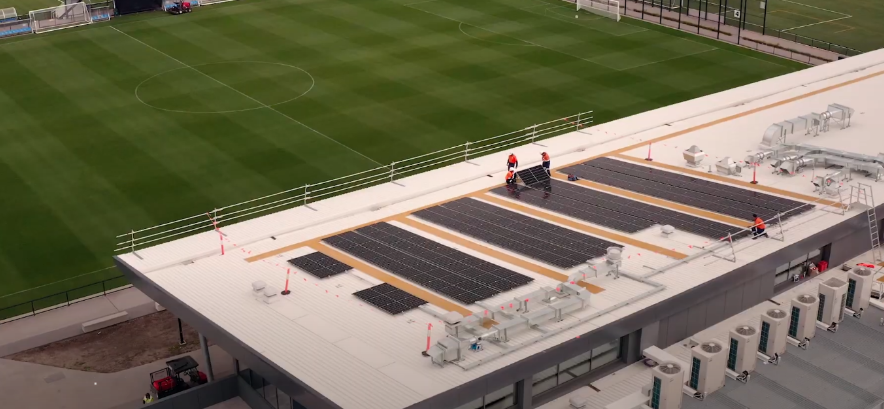
Melbourne City FC and Origin are proud to announce a significant milestone in their partnership with the installation of rooftop solar panels and battery storage at the newly opened City Football Academy Melbourne at Casey Fields. The newly installed 40 kW rooftop solar system is expected to generate approximately 50 MWh of electricity annually, while a 13.5 kW battery storage system helps to ensures the club’s operations can function efficiently . This initiative is a significant stride for Melbourne City FC towards reducing it’s carbon footprint at their state-of-the-art facility.
Commenting on the partnership, Melbourne City FC CEO, Brad Rowse, said:“As a club, we pride ourselves on innovation and making a positive impact on our community, and we are fortunate to have a partner in Origin that shares similar values.”
Origin, now in its third year as a partner of Melbourne City FC, has demonstrated its commitment to help the club reduce its carbon emissions by implementing renewable energy solutions to power its football and administration operations.
4. Origin news and updates
4.1 Origin has agreed to acquire the Yanco Delta Wind Farm in the Riverina
Origin has entered into an agreement with Virya Energy to acquire its Yanco Delta Wind Farm, one of the largest and most advanced wind and energy storage projects in New South Wales. Yanco Delta, consists of a 1.5 GW wind farm and an 800 MWh battery. This acquisition marks an important step in Origin’s ambition to lead the energy transition through cleaner energy and customer solutions.
4.2 Origin acquires renewables developer Walcha Energy
Origin has acquired renewable energy developer Walcha Energy, including the Ruby Hills Wind Farm and Salisbury Solar Farm, with up to 1,300 MW of planned capacity.
The acquisition of Walcha Energy is consistent with Origin’s ambition to lead the energy transition, specifically the strategic priority to accelerate renewables and storage in our portfolio.
5. Energy market updates and reports
5.1 The expanded Capacity Investment Scheme
The Capacity Investment Scheme (CIS) provides a national framework to encourage new investment in renewable capacity, such as wind and solar, as well as clean dispatchable capacity, such as battery storage.
It aims to help build a more reliable, affordable and low-emissions energy system for all Australians. An expansion of the CIS was announced in November 2023. The expanded CIS seeks to incentivise the national deployment of 32GW of renewable capacity and clean dispatchable capacity by 2030.
Competitive tenders for the expanded CIS will be held approximately every six months, which began May 2024. This represents a potential source of significant new generation supply into, and a meaningful intervention in, the National Electricity Market.
About the Capacity Investment Scheme – DCCEEW. (2023, December 15). Dcceew.gov.au.
5.2 Renewables continued to increase NEM market share
During the first quarter of 2024, the output from all generation sources, except gas-fired and hydro stations, increased to meet the growing demand in the National Electricity Market (NEM). Renewables led this surge, raising their overall share of total NEM supply to 39.0%, up from 37.4% in the same period the previous year. Grid-scale solar generation had the greatest increase in output, with an 18% lift in quarterly average output from the previous Q1 to a new record of 2,164 MW this quarter. This increase continued to be driven by new and recently commissioned capacity in New South Wales and Queensland.
Read more in the Aemo Quarterly Energy Dynamics – Q1 2024 here.
© 2024 Australian Energy Market Operator Limited. The material in this publication may be used in accordance with the copyright permissions on AEMO’s website.