
This article and its contents were written and correct as of October 2022, with updates to reflect proposed governmental changes in January 2023. The content is general in nature, and businesses should seek their own advice.
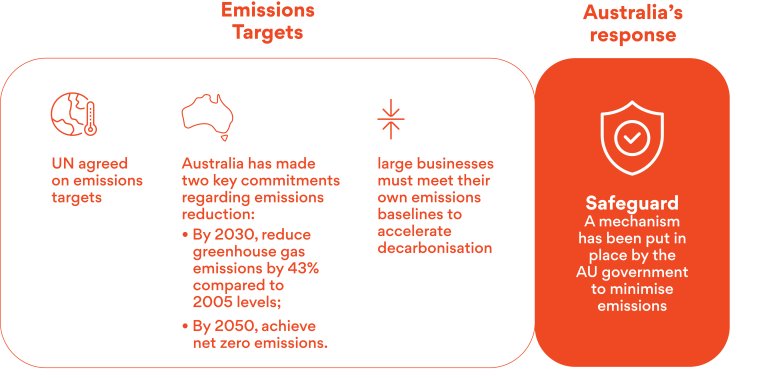
Australia has recently increased its legislated emissions reduction target. The nation is committed to a 43% reduction in carbon emissions, compared to 2005. Australia is also committed to net zero emissions by 2050.
To assist in meeting these targets, the Australian Government will build on the existing Safeguard Mechanism which requires the nation’s largest carbon emitting businesses to meet their own specific carbon emissions benchmarks.
These businesses are obliged to report their emissions and are accountable for the results. Year on year, the amount of carbon a business emits has to be below a prescribed baseline, so they must take measures to ensure they meet their obligations. The government is proposing to gradually reduce baselines to help meet the new emissions targets, which would strengthen the need for ongoing action to reduce emissions.
Origin Zero partners with large businesses to provide solutions that help decarbonise operations.
What is the Emissions Reduction Target?
In 2015, leaders from 195 countries and the UN came together to agree on a unified global approach to combating climate change. The resulting Paris Agreement is an international treaty committing nations to make significant efforts in reducing emissions to mitigate climate change. The overall goal of the Paris Agreement is to limit global temperature change to less than 2, preferably to 1.5 degrees Celsius, above pre-industrial levels.
Under the agreement, many nations publish Nationally Determined Contribution plans, which outline the climate actions they are taking. At the core of Australia’s Nationally Determined Contribution sits our Emissions Reduction Target, an overall greenhouse gas emissions reduction goal with milestones to keep us accountable on the journey.
Australia has made two key commitments regarding emissions reduction:
- By 2030, reduce greenhouse gas emissions by 43% compared to 2005 levels;
- By 2050, achieve net zero emissions.
Why do Emissions Reduction Targets exist?
Emissions Reduction Targets exist to hold nations accountable for their climate responsibilities and Nationally Determined Contributions. By having targets in place with interim milestones, nations can measure progress and, if necessary, take actions to accelerate decarbonisation.
What is the Safeguard Mechanism and why does it exist?
The Australian Government introduced a Safeguard Mechanism in July 2016, which requires large businesses to meet their own specific Scope 1 carbon emissions baselines. Think of it as an Emissions Reduction Target for individual businesses, pre-set for them by the Clean Energy Regulator, the independent body responsible for administering environmental and carbon reduction schemes in Australia.
Of course, many Australian businesses understand the benefits of low carbon operations and set out to meet and beat their safeguard levels as a matter of good business practice, regardless of their legal obligations.
The government has now proposed changes to drive further progress and ensure businesses subject to the safeguard deliver their proportionate share of Australia’s emissions reduction. These changes include a proposed target to shrink scheme emissions to 100 Mt CO2-e per annum by 2030, which represents about a 30% reduction on currently covered annual emissions, while also introducing $600 million in incentives to trade-exposed facilities to help them manage competitiveness and carbon leakage risks. The reforms need to be finalised before going live on 1st July 2023.
Who does it affect?
Facilities or businesses where Scope 1 emissions* exceed 100,000 tonnes of carbon dioxide equivalent (CO2-e) per year are accountable under the Safeguard Mechanism. There are some eligibility exceptions depending on industry sector.
The Australian Government is exploring approaches to tighten existing facility baselines and reduce them over time to strengthen emissions reduction incentives. Measures, such as the incentives listed above, are also being considered to ensure emissions-intensive, trade exposed businesses are not materially disadvantaged relative to foreign competitors resulting in less controlled, yet greater emissions, being made overseas.
*Scope 1 emissions are carbon emissions from sources directly controlled or owned by an organisation (e.g. the fuel they use at their facilities, to power their business vehicles, etc.).
What obligations do affected businesses have?
The main obligation for businesses under the Safeguard Mechanism is to keep net emissions at a level less than or equal to the baseline figure they’re prescribed.
Responsibility to meet the baseline falls on a nominated ‘responsible emitter’ within a business, and that may be an individual, a trust, a body corporate, a local governing body or a corporation.
Affected businesses are accountable to report their emissions figures and company activity regularly contributing to emission reduction and avoidance in keeping with the National Greenhouse and Energy Reporting Act. This means regular and compliant reporting on the sources they are monitoring, the data they are using for calculations, the methods they use for estimations and thorough reporting of business decisions relating to emissions-intensive business activities, amongst other things. Penalties for non-compliance apply.
What options does a business or facility have if it fails to meet its benchmark?
The main guidance for businesses which are forecast or concerned that they will miss their benchmark is to implement less emissions-intensive practices in their daily operations. This could include finding more efficient ways to use energy, such as generating energy on-site via solar, or by storing energy in commercial batteries, by transitioning vehicle fleets to electric power, or by implementing other sustainable energy usage practices. Businesses can take action to help bridge the gap between their operational carbon emissions and their benchmark.
Alternatively, businesses can currently:
- Explore other options available to them with the Clean Energy Regulator
- Purchase and surrender Australian Carbon Credit Units (ACCUs) to offset their carbon output and reduce their net emissions.
- Apply for an exemption on the basis that circumstances have made it impossible for them to meet their baseline.
Exemptions are only issued under extraordinary circumstances, such as natural disasters.
All Safeguard Mechanism facilities with emissions below their baseline will be able to generate credits, except landfills and facilities accessing multi-year monitoring periods, borrowing arrangements, and deemed surrender provisions.
Each of the above applications must be made to the Clean Energy Regulator before certain deadlines, alongside documentation to support increased efforts to reduce carbon emissions.
How can Origin Zero help?
Origin Zero’s mission is to accelerate Australian businesses on their decarbonisation journey. Helping businesses to reduce carbon emissions in their operations and meet their Safeguard Mechanism benchmarks is a key part of our work.
As an end-to-end provider of energy solutions, we partner with businesses to assist in the journey to net zero, diagnosing operational issues at the source and building tailored, effective, sustainable energy plans to help businesses decarbonise.
Talk to us about our range of carbon reduction options today.