With the increasing speed of tech change and innovation, sometimes it can be hard to keep up with latest facts and information. For example, when it comes to EVs, several past facts have now become falsehoods as technology has advanced. And some were never even facts to begin with.
We asked out EV experts for some of the most common, and weirdest, EV myths they’ve heard and got to work busting them!
They’re more expensive than traditional cars
As technology evolves, it typically becomes more affordable and efficient, and EVs are no exception. Initially, EVs cost up to twice as much as comparable internal combustion engine (ICE) vehicles. However, with an increasing number of manufacturers entering the market and technology improvements, the price of EVs is decreasing and becoming more affordable. Today, there are many EVs available at a variety of price points, including several under $40,000.
When considering the total cost of ownership, EVs can be more economical to operate than petrol or diesel cars. The Electric Vehicle Council EV cost of ownership page can help you understand the costs associated with EVs in more detail.
There isn’t enough charging infrastructure
As more people start adopting EVs, it’s true there will be a need for more public charging infrastructure in high-density inner-city areas (where many residents don’t have access to off-street parking). However, if you’re away from home and travelling long distances, the public charging network in Australia is already well built out and improving by the day. From Adelaide all the way up to North Queensland, there’s good charging infrastructure and via a smartphone app or your car’s digital screen, you can see which chargers are available and where they’re located.
When it comes to inner-city areas, many apartment complexes are already installing, or looking to install, EV chargers for their residents. As of October 2023, all new developments must make provisions for EV charging.
You need a special charging set up
Yes and No. It really depends on your personal situation. For efficient home charging, we recommend installing a Level 2 dedicated wall charger, which offers faster charging speeds.
For those who depend on public charging, you can use resources like PlugShare. Find out more about the basics of EV Charging.
Charging is too expensive
Charging your EV comes with different price tags depending on how you go about it. Most EV owners prefer to charge at home or work – roughly 80% choose to charge their vehicles at home overnight – allowing them to set charging schedules to take advantage of cheaper electricity. This includes solar power during the day and off-peak rates at night. This savvy charging strategy can slash your costs by up to 90%, compared to filling up an ICE vehicle.
When on the road, public fast chargers are a great option but generally cost more than private charging. Savvy EV drivers can also use free charging services like Jolt, that offers 7kWh of free charging each day.
If you’re a Tesla owner, with Origin EV Power Up you can access 8c/kWh EV charging – that could mean less than $5 for a full charge*.
The cost of maintenance is expensive
Once you’ve purchased an EV, running costs can be up to 90% lower than a petrol car.
Ongoing costs include maintenance and fuel. As an example, a tank per week in a 60-litre petrol car could cost over $350 per month, when the equivalent amount of driving in an EV will cost around $70 per month (if you’re paying top dollar at external chargers). More likely, when charging at home, you’ll experience cheaper charging costs.
Then there are servicing charges, which are significant in a petrol car. But as there are so few moving parts in an EV, services are quicker and less expensive. Air filters, tyre and brake wear, etc, still need to be checked, but most of the messy and expensive work – oils, spark plugs, bearings, gaskets and so much more – is no longer required.
The driving range of EVs is unacceptable in Australia
As most car journeys are short – according to the Australian Bureau of Statistics, the average Australian passenger car travels around 33 kilometres per day – charging time and the cost to top up each day at home is negligible. And, if your home (or workplace) has solar and you charge during the day, charging can potentially be free.
EVs available in Australia can travel 300 to 650 kilometres per charge – and not many people drive that far in a day.
For long trips, perhaps an annual holiday, there’s a public charging network where cars can fully charge from 0% in 20 to 60 minutes. More likely, you’d be filling up from around 30% and require less charging time. With some careful planning on route, travelling long distances is entirely possible.
They’re weird to drive
There are a couple of notable difference between EVs and ICE cars that may seem strange at first.
EVs are much quieter than ICE vehicles because they don’t have an engine or exhaust system. EVs deliver instant torque, meaning they can accelerate very quickly right from a stop. Typically, EVs have simpler transmission systems, often using a single fixed gear ratio – and there’s no gear shifting, either manual or automatic, which simplifies driving.
The design and user interface in EVs can also be quite different. Many EVs utilise digital interfaces extensively and may have different placements for buttons and controls, focusing more on technology and connectivity features.
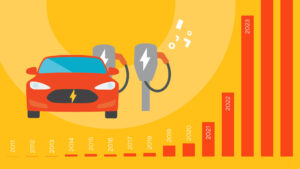
These differences can make EVs feel ‘weird’ or unfamiliar at first, especially for those who have been driving ICE vehicles for a long time. However, the growing number of EV sales in Australia paints a promising picture of what people enjoy driving – in 2023 alone, EV sales increased by a whopping 161 per cent!
You can’t hear an EV approaching
When an electric vehicle (EV) travels at speeds above 30km/h, it produces noise levels like those of an ICE car. This is due to road noise, rather than engine sound. Below this speed, however, EVs can are quiet and harder to hear. As a result, manufacturers have incorporated artificial sounds into EVs to alert pedestrians of their presence. Some manufacturers are getting creative and using composers to develop a sound for their EVs.
You can be electrocuted when driving in the rain
Electric cars are just as safe to drive in the rain as ICE cars, thanks to rigorous safety standards. To safeguard drivers from electrocution and other electrical risks, the battery, charging system, and other components undergo extensive testing and certification. This ensures you can safely charge your car and navigate through puddles or rain without the risk of electrocution. However, just like ICE cars it is recommended not to drive through flood water.
Batteries end up in landfill
EV batteries are a valuable resource that after use in an EV can be repurposed for second life application for grid storage — think home batteries for solar or being recycled to recover raw materials for new batteries.
In Australia, the Association for the Battery Recycling Industry (ABRI) plays a crucial role in promoting a circular economy for batteries and ensuring EV batteries avoid landfill. To better understand the lifecycle of EV batteries, check out the Electric Vehicle Council infographic and information page.
EVs can’t tow
Electric motors, like their ICE counterparts, can handle heavy loads – producing their torque almost instantly from when the motor starts spinning. Unlike internal combustion engines which need to build up speed before producing max torque. The challenge with electric motors, is they need a lot of electricity (transported in a battery pack), but it is possible – just look at trains and trams.
If your lifestyle means you need towing power, it’s important to factor this in when researching which EV is right for you.
At present, the EV with the largest tow capacity is the BMW iX large SUV, which is rated to tow up to 2.5 tonnes. While EVs at present have significantly lower towing capacities to traditional petrol cars, the demand for towing capabilities is growing.
EVs damage the road
It stands to reason that the heavier the car, the more friction between tyres and road, resulting in roads deteriorating quicker. The reality is that heavy vehicles and lighter vehicles can be both ICE and EVs.
EVs are generally 300kg to 400kg heavier than their ICE equivalents due to their batteries. If you think about Australia’s new car buying trends, you’ll find Australia’s top selling vehicles Ford Ranger and the Toyota Hilux are both dual cabs and their kerb weight starts from 1950kg to 2,296kg. Compare that to the Telsa model Y kerb weight is around 1911 to 1981kg.
This myth began when the University of Edinburgh calculated that EVs have a 20-40% higher road wear rate than ICE. However, the assumption was incorrect. Instead, it was determined road damage is caused by large vehicles like buses and trucks.
Anybody who’s driven an EV will tell you that the instant-on power makes the driving experience about as much fun as it can be. Find out how we can get you, or your business, in an EV sooner.
*Based on a continuous electricity charge rate of 8c/kWh powering a Tesla Model Y with a useable 57.5 kWh battery. The estimated cost is $4.60 to charge a Tesla Model Y (RWD) from zero charge to full capacity with Origin EV Power Up.