
This article and its contents were written and correct as of November 2022.
What is the PDRS?
The Peak Demand Reduction Scheme (PDRS) is a program introduced by the New South Wales Government, to incentivise households and businesses to reduce energy consumption during peak demand. According to the NSW Government, the scheme supports its net zero emissions target while ensuring grid reliability and energy security during times of peak demand.
The PDRS works by creating a market for Peak Reduction Certificates (PRC’s) and by requiring Scheme Participants (mainly electricity retailers) to surrender a certain number of PRCs each year. The certificate scheme commenced in November 2022.
Why is it being introduced?
In 2021, the NSW Government increased its 2030 emissions reduction target from a 35% reduction to a 50% reduction, on 2005 emissions levels. The state aims to be net zero by 2050, consistent with Australia’s national target.
The NSW Government is introducing a range of schemes and legislation to meet its emissions reduction targets. These schemes set out to reduce emissions in two ways:
- By encouraging businesses and households to be more sustainable with their energy usage; and
- By creating an attractive financial market for private sector investment in sustainable projects and technology.
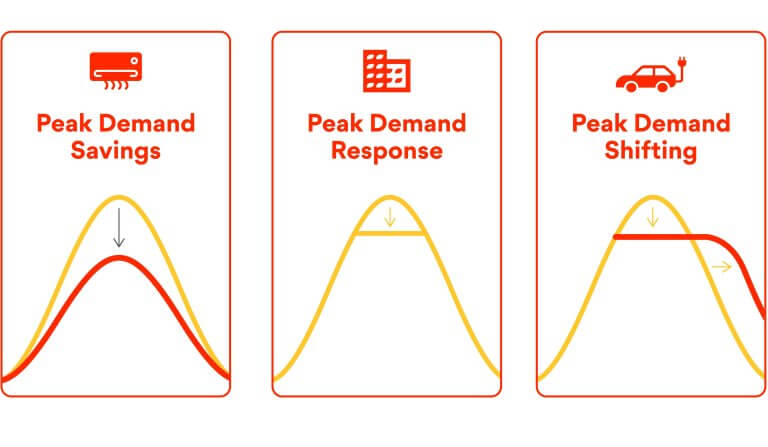
The PDRS is a scheme which incentivises businesses and households to use energy efficient appliances so that they reduce their energy usage during times of peak energy demand. These times are typically between 2:30pm – 8:30pm during the hotter months, when the demand for air conditioning and refrigeration can put pressure on the state’s electricity grid.
Who does this involve?
Several parties participate in the PDRS.
Accredited Certificate Providers (ACPs) are businesses that provide energy efficient appliances which reduce peak demand to household and business energy users. For doing so, they are granted Peak Reduction Certificates (PRCs) which they can sell to Scheme Participants.
- Scheme Participants (typically energy retailers, like Origin) are businesses that are mandated by the NSW government to participate in the PDRS scheme. These participants can participate by purchasing and surrendering a pre-defined amount of PRCs each year. Scheme Participants are the buyers in the market, purchasing PRCs to meet their compulsory legal obligations.
- Energy users have the choice to engage with ACPs to have energy efficient appliances installed on their premises, driving the creation of PRCs. Equally, energy users (both household and business) will notice an increase in their energy prices, as Scheme Participants pass on the costs of purchasing PRCs, to their customers.
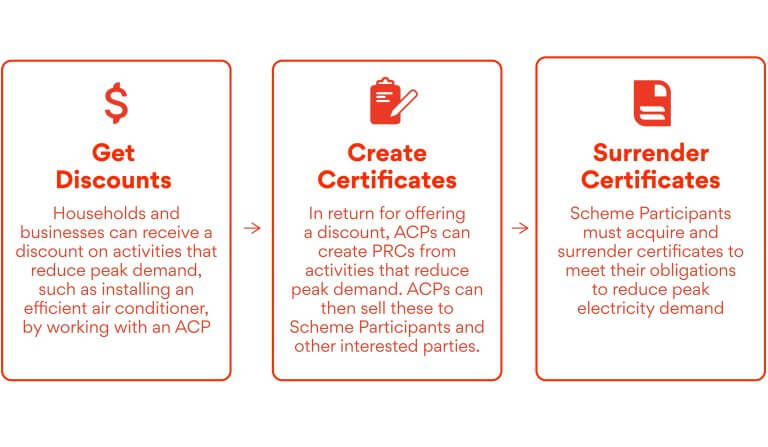
One certificate is created for every 0.1 kilowatts of peak demand reduction capacity averaged over one hour during the peak summer period.
The cost for energy retailers to purchase and surrender PRCs will be passed on to customers as a line item on their energy bills. For Origin’s large business customers, this began on September 1st, 2022, and will apply all year round to smooth the cost impact rather than the charge only being applied during the peak months.
What is the initial focus of PDRS?
PDRS is being launched in phases. To begin with, the focus applies mainly to households and small businesses, as the PRCs incentivise installation of efficient small to medium-scale appliances. For example, efficient air conditioners, boilers, fridges, and freezers generate PRCs.
What might PDRS look like in the future?
Over time, the PDRS may expand to reward installers of appliances and technologies which shift usage away from peak times and allow customers to actively control appliances during peak times to reduce demand on the electricity network.
These types of smart appliances are already in the market and are becoming more common and cost effective as the technology continues to improve.