
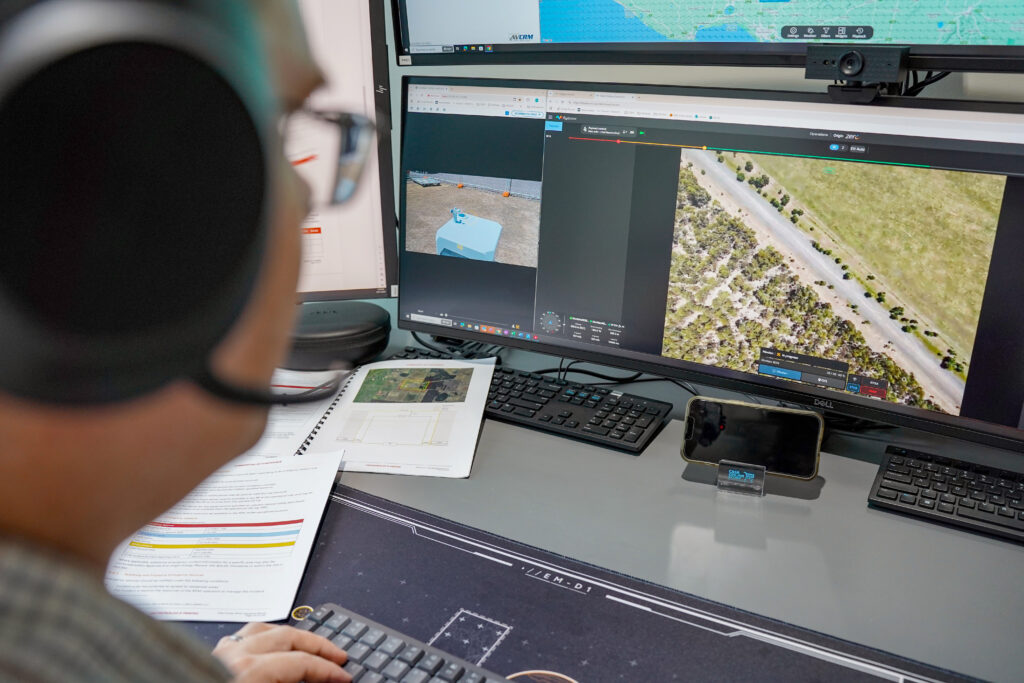
In a cordoned-off corner of our Brisbane office, Chief Remote Pilot, Matt Jeffs, is gearing up for another drone flight. He conducts final checks, eyes flitting across three monitors displaying various data, video feeds, and charts.
“Preparing box,” Matt speaks into his headset. “Prepare for take-off… Spinning up… And we’re off.”
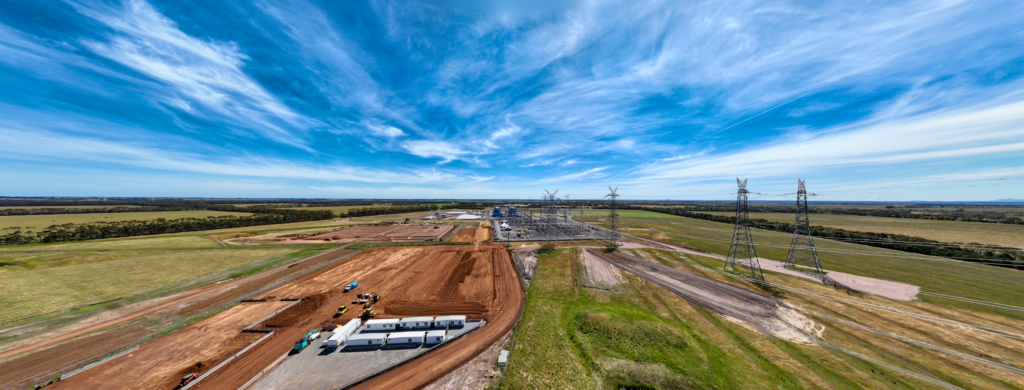
Nearly 1,750 kilometres away at Victoria’s Mortlake Power Station, a drone comes to life. Emerging from its “drone-in-a-box” station—a container doubling as its landing pad and charging hub—it ascends smoothly. Following a pre-programmed route, it surveys the construction of a 300-megawatt large-scale battery taking shape next to the power station.
Back in Brisbane, Matt keeps a close eye on the drone’s journey. He checks the airspace, chats with any nearby pilots if needed, keeps tabs on the weather, and makes sure everything’s running smoothly.
As the drone flies over the site, it captures sharp, detailed aerial images. These images are later processed to correct any distortions, ensuring they match up perfectly with maps and elevation data. The outcome? Clear, reliable insights that help the Mortlake Battery project team track progress, visualise the site, share updates with off-site team members, and plan upcoming activities more effectively.
Breaking barriers with beyond visual line-of-sight approval
A game-changer for Origin, this operation represents a major leap forward, enabled by recent approval from the Civil Aviation Safety Authority (CASA) for Beyond Visual Line of Sight (BVLOS) drone operations. This approval allows our qualified operators to pilot drones from its Brisbane Remote Operations Centre, even when those drones are located hundreds or thousands of kilometres away.
The drone-in-a-box system at Mortlake highlights the potential of this technology. With its ability to autonomously launch, land, and recharge, allowing us to remotely track construction progress, reducing the need for on-site personnel.
“The drone at Mortlake has been flying twice a week since the project began in August,” Matt says. “For much of the Mortlake Battery team, who are based off-site, this technology is a valuable tool. It lets us inspect activities, track changes, and measure site features—all without being there in person.”
Revolutionising project management
Origin Project Engineer James King, involved in the Mortlake project from the start of construction, says, “Sharing drone-captured imagery with the team has transformed how we track progress— it’s often easier to convey progress visually than through written updates.
“For instance, our project scheduler uses these images to track the progress of construction, identifying areas where we’re ahead or behind schedule.
“Personally, I’ve found it incredibly useful to overlay site drawings onto drone photo maps to anticipate potential challenges.”
A future in flight
Years of development, rigorous testing, and regulatory hurdles have culminated in this moment. The Mortlake project is just the beginning of our ambitions in utilising drones.
“We’re thrilled to be at the forefront of drone operations within the energy sector,” Matt says.
“Deploying drone-in-a-box solutions like this one at key sites across our portfolio is just the start. As drone technology continues to evolve, we anticipate even more innovative applications to emerge.”
“For Origin, the skies are not the limit—they’re just the beginning.”