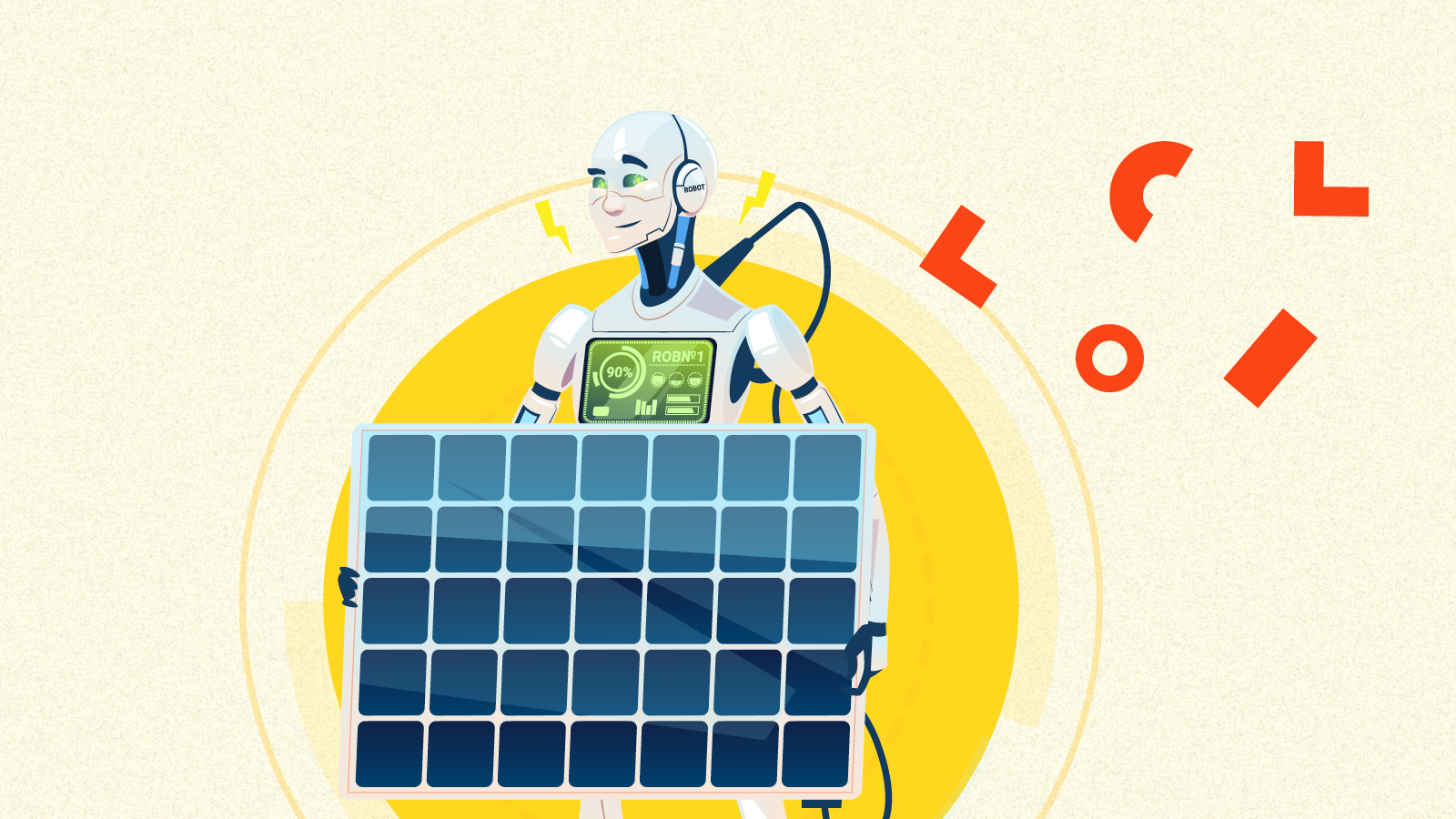
Does the mention of artificial intelligence (AI) bring to mind visions of killer robots intent on world domination? You’re probably not alone, but you may have watched The Terminator a few too many times…
What we’re actually talking about is technology that can do what a human usually does. Lots of industries generate and use data – like gaming, shopping, cars, and even energy. AI is disrupting the way we do things, and it’s completely changing the way our whole energy system operates.
And this is what we’re exploring in the latest episode of So Watt? – a podcast about energy hosted by Dom Fay and Zach Mander from Collective Noun. So, what role does data and artificial intelligence play in the energy transition? Tune into episode three below or read on to find out.
Let’s delve into how these new technologies will help to manage and control energy supply, demand and storage – including the coordination of large-scale generation right through to devices in our homes.
Screen time
Let’s start by going behind-the-scenes of Origin’s Monitoring and Support Centre, where the output from all of Origin’s power plants are controlled. It’s basically a room with a lot of screens, and each screen has data on each power plant, and the National Electricity Market (NEM), including how much wind and solar generation is out there, and what other power stations are doing.
When the NEM needs more energy, the team at Origin’s Monitoring and Support Centre turn on more gas turbines, or ramp up the output from pumped hydro, to make sure there’s enough. And when there’s a lot of solar or wind during the day, they scale back other forms of generation.
Essentially, energy in the grid needs to balance supply and demand at all times. So, the team processes a huge amount of data each day to do that. In fact, there are over 3 trillion data points – and that’s growing every day!
Predicting the future
Machine learning and AI play a key role in taking all this data to predict and manage changes across the grid – and it has the potential to unlock huge possibilities.
One of the key things AI allows us to do is forecast. You’ve heard of weather forecasting, economic forecasting and predictions on fashion trends… Well, renewable energy production and energy consumption also need to be forecast to get the balance right – which means managing fluctuations in renewable energy generation when it’s cloudy or the wind stops blowing.
And it’s data science (we swear this isn’t just a fancy way of describing someone who’s really good at Excel) that allows us to make these predictions.
As we transition away from an energy system built around large centralised power stations, to a more renewable one with millions of points of generation (think rooftop solar) and changing electricity demand, there will be more data and more variability to manage. Making the role of data science and forecasting critical.
The home of the future
AI could be vital to unlocking the grid of the future. It could help to use all of that data to manage the energy grid, determine where energy is needed and where that power needs to come from. It could also help Aussie households become smarter.
For example, AI can orchestrate a home’s energy requirements on behalf of the occupants.
If you have rooftop solar, a home battery, heating and cooling, an EV or other smart and flexible devices – then smart tech could turn them on and off at the best times to minimise your energy costs and maximise comfort… All while helping to manage demand on the grid. You wouldn’t even need to flick a switch. Pretty smart, huh?
It’s all about managing flexibility in supply and demand – because renewables are variable, demand must be more flexible too. And one way to achieve this demand flexibility is with the assistance of AI.
Hosts, Zach and Dom from Collective Noun admit they know nothing about energy – but not for long! Origin’s So Watt? podcast questions everything you thought you knew about energy, and explores the solutions that exist today. In season two of So Watt?, go on a journey with Zach and Dom to find out more about the transition to renewables, what changes are already happening and what’s coming up.