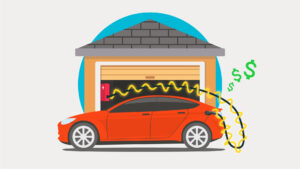
There’s charging your EV and then there’s Powering Up your EV
If you’re reading this, you probably have an electric vehicle (EV). Maybe you bought it because you thought it was cool (they are) or because you wanted to reduce your carbon footprint (they can help too). Or maybe you were just tired of being held upside down by your ankles at the service station and watching all the money drain out of your pockets and into the tank.
If it’s the latter, this article will be particularly relevant, but no matter what reason you have for owning, or wanting to own, an EV, you’ll most certainly want to make the most out of it financially. And that’s where Origin EV Power Up comes in.
Getting more bang for your EV buck
Just like petrol prices move up and down due to supply and demand, electricity prices also fluctuate, and the price of charging your vehicle can vary. We all know charging your EV is cheaper than filling up a tank with petrol, but the advantages of an EV charge can go even further. Imagine a world where you could fill your car with petrol, at the same great rate, each time you visit the bowser. Well, with a Tesla EV and Origin EV Power Up, that kind of thinking is a reality.
How Origin EV Power Up works
By using smart tech in the Origin app, Origin EV Power Up ensures your Tesla has access to a lean 8c/kWh electricity rate^. All you’ll need is the Origin app, a residential Origin electricity plan and your Tesla. Simply pair your Tesla via the app, set the time you need your car’s charge to be completed by, then plug in and save.
Conveniently, EV Power Up uses the same charging cable you’re already using at home, and you don’t need to change your Origin energy plan. The only change you’ll need to make is ensuring your compatible EV is plugged in whenever possible when you’re at home, and that you’ve set your charge-ready time.
You’re probably thinking, where’s the catch? What will happen if I charge during peak times while using EV Power Up? Great question, we’re glad you asked! Origin EV Power Up works by finding low-cost energy to charge your Tesla EV, like when there’s excess solar during the day or when demand is lower overnight, and avoids charging during peak demand times, when energy is usually at its most expensive (and sourced from gas and coal). If you do need to charge during peak times, we offer an ‘Instant Charge’ feature, but more on that shortly.
So, when should I charge?
If you’re at home, for EV Power Up to work at its fullest potential, you should have your EV plugged in as much as possible. This allows us to find cheaper energy, which can include renewable sources, and ensure your EV has enough time to charge.
Peak times typically fall from 5pm to 9pm – although other events, like weather patterns, can influence when a peak period takes place. In most cases though, there’s no need to dust off the crystal ball to foresee electricity prices, all you have to do is ensure your EV’s plugged in at home, and make sure you’ve set a charge-ready time with enough time left in non-peak hours to complete your charge.
What if I need urgent access to my EV?
No problem, you can still use the Instant Charge feature whenever you want with a schedule override feature. Instant Charge means we’ll start to charge your EV straight away. The only trade-off? You won’t receive the Origin EV Power Up 8c/kWh charge rate for that session, you’ll be charged at the standard rate on your energy plan. With EV Power Up, you still have complete control of your charge using the Origin app — our app also offers usage data to help you tweak your habits for optimal efficiency. Helping you charge smarter and cheaper.
How will my billing work?
By now you’re probably wondering exactly how you pay less per month than before. Initially, you’ll be charged the same amount as you’d normally pay on your energy plan. We’ll then apply a monthly credit to your bill based on the amount of electricity used to charge your EV using Origin EV Power Up. This amount is calculated using charging data from your EV. The credit applied means you’ll only be charged 8c/kWh for any scheduled EV charging through Origin EV Power Up.
So, ‘watt’ next?
Ready to take control of your EV charging? Link your car, set your charge-ready time, and power up your savings with Origin EV Power Up. Be one of the first to experience the future of EV charging.
Disclaimers
#Currently, only Tesla vehicles are eligible for Origin EV Power Up, but we are working on supporting more EV manufacturers. Supported Tesla vehicles include: Model S, Model X, Model 3, Model Y. Residential addresses with life support dependency and controlled load functionality are ineligible.
^Usage charges will initially be charged in accordance with your energy plan, we’ll then apply a monthly credit to your bill based on the charging data reported from your vehicle during the previous month for scheduled charging sessions managed by Origin EV Power Up. The credit applied will mean you’ll only be charged 8c/kWh for any scheduled EV charging through Origin EV Power Up.
*Based on a continuous electricity charge rate of 8c/kWh powering a Tesla Model Y with a useable 57.5 kWh battery. The estimated cost is $4.60 to charge a Tesla Model Y (RWD) from zero charge to full capacity with Origin EV Power Up.
^How we calculate annual car travel cost estimates
The vehicles used for cost comparisons: Tesla Model Y (RWD) and Mazda CX-5 MAXX. Prices and costs are correct at December, 2023. We calculate the estimated cost by multiplying the electricity needed to charge the EV across the full 12,100km distance (57.5k kWh useable battery for the Tesla Model Y) by the cents per kWh charge for each charging method. We calculate the estimated petrol cost (56 litre fuel capacity for the Mazda CX-5) by multiplying the petrol needed to travel the full 12,100km at an average rate of $2 inc. GST per litre.
- Origin EV Power Up travel cost estimate: The estimated cost of $122.33 inc. GST to charge a Tesla Model Y (RWD) with Origin EV Power Up exclusively used to power every charge at a rate of 8c/kWh inc. GST.
- Petrol SUV travel cost estimate: The estimated cost of $1,984.40 inc. GST annual fuel running cost is based on a Mazda CX-5 MAXX at average cost of $2 inc. GST per litre of unleaded petrol.
- EV Supercharger travel cost estimate: The estimated cost of $1,055.09 inc. GST to charge a Tesla Model Y (RWD) is based on 12,100km travelled with a Tesla Supercharger exclusively used to power every charge up to that range at a rate of 69c/kWh inc. GST; rate based on Zecar Charging Guide.
- *The difference between charging your base Tesla Model Y or Model 3 at home based on a Default Market Offer (DMO) rate of 37.56c/kWh inc. GST for household on a flat rate tariff in the Ausgrid network region of NSW versus charging your car exclusively at home via Origin EV Power Up, is a difference of approximately 78%.
- EV home charging (DMO comparative rate) electricity travel cost estimates: The estimated cost of $574.34 inc. GST to charge a Tesla Model Y (RWD) is based on a Default Market Offer (DMO) rate of 37.56c/kWh inc. GST for household on a flat rate tariff in the Ausgrid network region of NSW.