Heating and cooling appliances account for around 40% of household energy usage in Aussie homes. Making sure you choose an energy-efficient heater can have a big impact on your energy costs and household budget. Here are a few things to consider, before we jump into specific heater types, to ensure you’re getting bang for your buck.
What is the Energy Star Rating and why does it matter?
While some appliances may seem like a steal at first glance, they could end up costing you more in the long run — this is where the Energy Rating Label comes in.
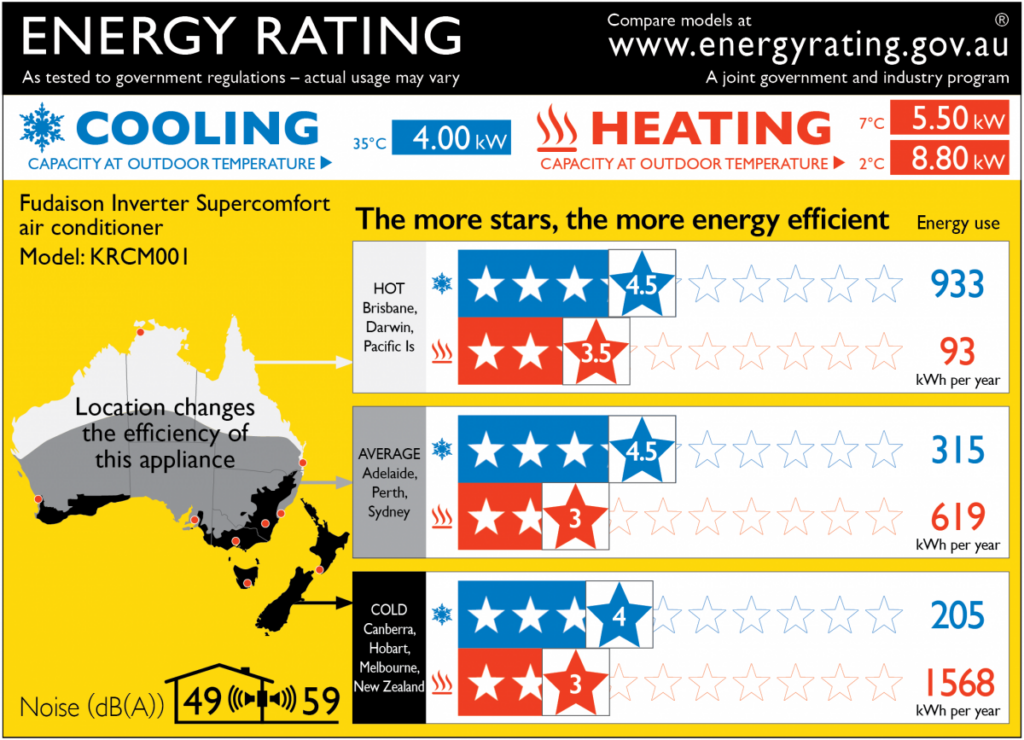
For most appliances, the Energy Rating Label is pretty straightforward – the more stars on the label, the more energy-efficient the appliance. The label allows you to easily see how much electricity an appliance will use compared to a range of models with similar features and capacities. However, for cooling and heating, the introduction of the Zoned Energy Rating Label means it functions slightly differently.
The Zoned Energy Rating Label began rolling out back in 2019, and while it’s most commonly seen on air-conditioners, you may also see it on heaters too. Unlike the common six-star method, the Zoned Energy Rating Label provides a rating based on the climate you live in – as the performance of air conditioners and heaters is often affected by the type of climate they operate in. The sticker provides an energy rating for three climate zones – hot, average and cold – allowing you to pick the appliance that performs best in your location.
How to calculate the running cost
There’s also another piece of advice on each label that can be used to figure out the real running costs – the annual energy consumption figure. To work out the cost of running your new appliance, it’s worth going to the store (or online) armed with the rate you pay for your electricity usage in kilowatt hours (kWh). For example, if you pay 24c per kWh for your electricity, you can use the average annual energy consumption figure on the Energy Rating Label to calculate the yearly cost to run.
If it says the appliances uses 542kWh annually, just multiply that by 24c, to come to an annual total electricity (usage) cost of $130.08. This will give you a great frame of reference between two items with the same star rating. This handy appliance calculator can also crunch the numbers for you.
What are my options for heating?
There’s certainly no shortage of heating options, but the most common include:
- Ceramic heaters
- Electric fireplaces
- Fan AKA space heaters
- Gas heaters
- Radiant heaters
- Reverse cycle air conditioners
- Split systems
How much space do you need to heat?
It’s important to consider how much space you’re trying to heat when purchasing a heater. If you need to heat larger spaces, like an open-plan living room, it may be worth looking into a reverse-cycle, split-system or a gas heater for the most energy-efficient option. However, if you’re heating a small area, like bedrooms, studies or a modest living room, an electric heater – ideally with a thermostat and fan – will do the trick.
Tip: If you’re chasing a heater for a small space, like your study, consider a heated throw. Electric throws are cheaper to run than heaters and can save you around $150 compared to other types of heating. They’re also the perfect addition to a weekend of movie watching on the couch. You can calculate the running cost of small appliances with this handy calculator.
What is the most energy-efficient heater?
But, which of these options is the most energy savvy? Generally, reverse-cycle air conditioners are the most energy-efficient heating/cooling option, followed closely by gas heaters. Though these usually require more investment initially, they tend to last longer than their portable counterparts. So, it’s important to weigh up your options before deciding.
If you’re in the market for a more portable solution, according to Canstar Blue, ceramic and oil-filled heaters are on average one of the more energy-efficient options. The most important thing to look at when shopping around is the amount of energy the heater uses on the Energy Rating Label and use the appliance running cost calculator to get an idea of how much it costs to run per hour.
Save energy with these heating tips
Whichever heater you decide on, make sure you use these tips to trap in as much warmth as possible this winter.
- If your heater has a thermostat set it between 18 and 20 degrees Celsius – this is the most energy-efficient temperature. Each degree above uses roughly 15% more energy.
- This one might seem obvious but heating the hub – like the living room – instead of individual rooms can have a big impact. Shut the doors to any rooms you’re not in, to trap heat in.
- Draughts can steal up to 25% of your heat in winter. Sling a door snake across the bottom of internal or external doors to stop chilly air from sneaking in.
- Similarly, draughts can also sneak in through gaps in your windows. So pull curtains and blinds shut when running your heater.
- Shut the doors to rooms you’re not in/heating.
- Switch your ceiling fans over to winter mode, this will push hot air down from the ceiling down throughout the room.