What are Frequency Control Ancillary Services?
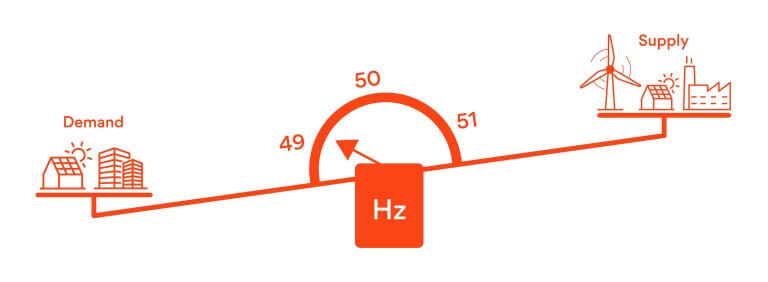
The Australian electricity grid requires both supply (generation) and demand (load) to be matched to operate safely.
The grid must operate at a frequency of 50Hz, or “cycles” per second, to avoid grid instability or, in extreme instances, blackouts. There is a “Normal Operating Frequency Band”, which operates between 49.85Hz and 50.15Hz.
To help maintain grid frequency, Frequency Control Ancillary Services (or FCAS for short) are used to manage reductions or injections of energy into the grid, when required. FCAS services are generally provided by gas or coal fired power stations and also batteries and are directed and procured by the Australian Energy Market Operator (AEMO) to ensure grid stability.
As the Australian grid continues to evolve, FCAS will remain a critical part of its ability to operate securely and reliably.
FCAS Markets
The FCAS market is made up of two distinct types of services: Regulation and Contingency.
Regulation frequency services act to correct minor deviations in load or generation. Each region has ‘raise’ and ‘lower’ regulation services, which are managed by AEMO directly with large generators, such as gas plants.
Contingency services can be supplied and enabled on site with participating large businesses at the equipment level (behind the meter), to help ensure frequency is returned to the normal operating band following an event. An ‘event’ occurs when the grid is outside of the Normal Operating Frequency Band .
The FCAS Contingency service is broken down into two components either a “raise service” or “lower service”. System frequency can be raised, by activities such as discharging a battery or reducing load .
System frequency can be lowered by businesses participating in FCAS markets, increasing their load use, charging batteries to increase the load taken from the grid, or stopping [electricity produced by] solar being sent to the grid.
AEMO directs and procures these kinds of activities using three different time-frame response levels: Fast (a response within 6 seconds), Slow (a response within 60 seconds) and Delayed (a response within 5 minutes).
Why are we talking about FCAS?
Many large businesses have energy assets which can be used to provide stability to the energy system whilst deriving revenue [for that business] through markets such as FCAS.
Assets such as solar or diesel generators that create power, or flexible loads, such as refrigeration or heating and cooling systems (HVAC), which can be turned on or off, can earn fees from AEMO by helping provide Contingency services. Asset owners can place these assets on stand-by to make them available for use within FCAS markets.
What is Origin Zero’s role?
Through Origin’s Virtual Power Plant (VPP) we can provide a way for businesses to share in the upside of supporting the grid in times of volatility whilst unlocking commercial value. By grouping assets, we can provide market services to help large businesses provide FCAS and access revenue streams from those services.